Discover Pioneer Florida
What did pioneer Florida actually look like? How did families build, eat, travel, and survive on the frontier? These articles dig into the places, structures, animals, plants, and ways of life that defined early Florida — before the highways and subdivisions arrived.
What Is a Dogtrot Cabin?
The House That Breathed
On a July afternoon in frontier Florida, the heat was not merely uncomfortable. It pressed down on everything beneath it — the palmetto scrub wilted, the cattle stood motionless in whatever shade they could find, and inside a single-room log cabin sealed against the sun, a pioneer family endured. Pioneer families needed a better house, and the dogtrot cabin — two log rooms joined by an open, breezy passage — was the answer they found.
Not the invention of any single architect, the dogtrot became the defining structure of pioneer family life across the Florida frontier: simple enough to build with hand tools, clever enough to make a Florida summer survivable, and spacious enough to hold a growing family and everything they had carried through hundreds of miles of wilderness to get there.
Two Rooms and a Breeze
At its simplest, a dogtrot cabin is two log rooms — pens of hewn timber, notched together at the corners — set ten to fifteen feet apart, connected by a covered open breezeway and topped by a single shared roof. The open passage itself was the genius of the design, not wasted space but the most important space in the house. Florida's prevailing breezes, pushed inland from the Atlantic and the Gulf, moved through a properly oriented dogtrot like a natural funnel, drawing air through the center of the structure and out the other side — the difference, in an era decades before mechanical cooling, between sleeping and lying awake in suffocating heat.
One room typically held the family's sleeping quarters; the other served as the main living and working space, centered on a fireplace for cooking and warmth. The breezeway between them was the true heart of the home in every season but winter — meals eaten there in summer, children playing in the afternoon heat, wet laundry drying, older family members watching cattle move across the pasture. It was porch, dining room, sitting room, and cooling chamber all at once.
Built From What the Land Gave
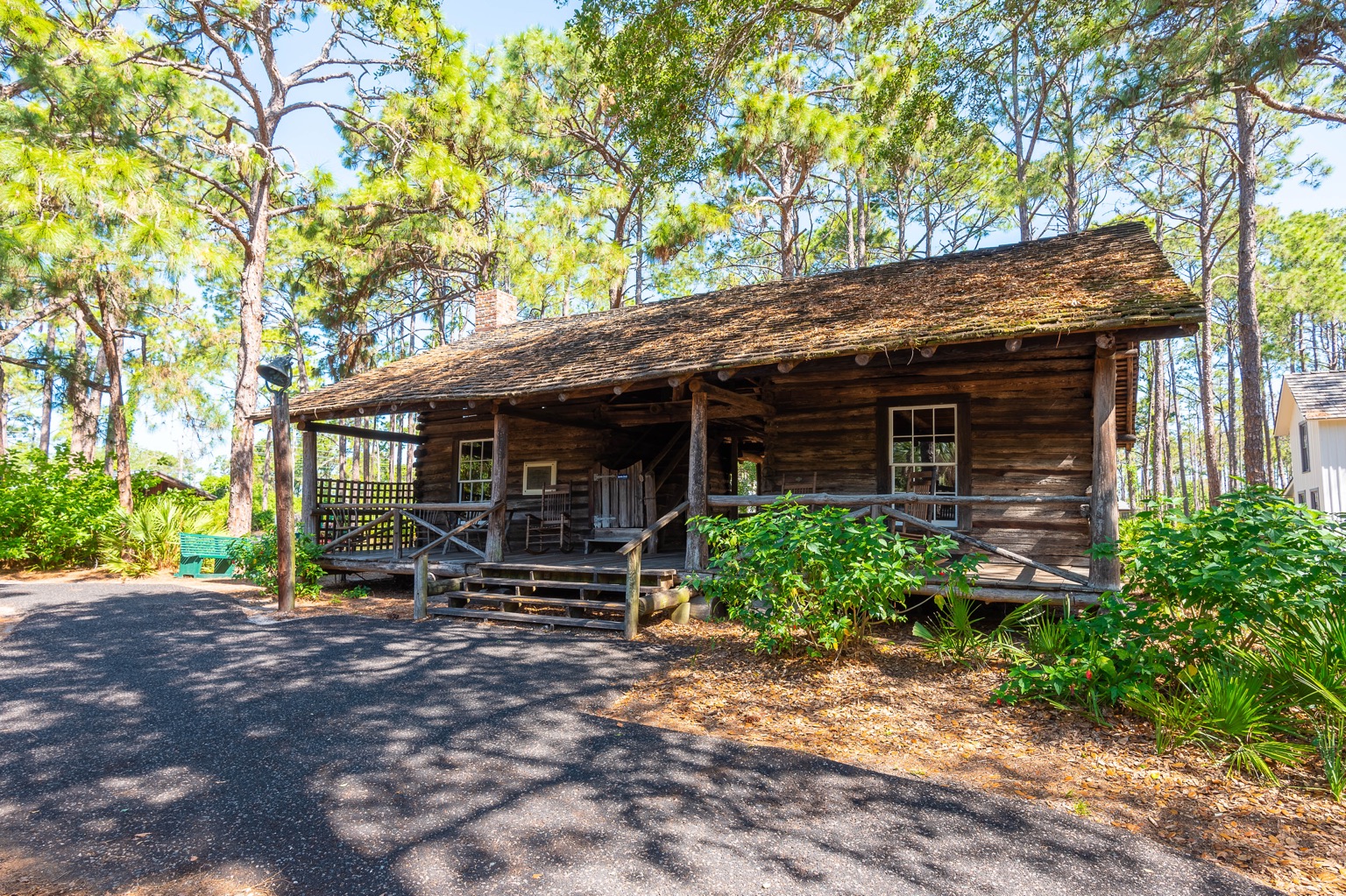
Pioneer builders worked from accumulated craft knowledge, not blueprints — traditions carried south by Scots-Irish and English settlers who had built similar structures across the upland South for generations. Longleaf pine, heavy and resistant to rot and insects, was the favored building wood across Florida's interior; cypress offered similar durability with even greater moisture resistance in the state's often-saturated ground. Logs were felled, limbed, and squared with a broadaxe, notched at the corners using the saddle notch or half-dovetail pattern, and stacked to lock together without nails. Gaps between logs were chinked with moss, clay, and stone, or lime mortar where coastal shell middens made it available.
Florida's own version of the dogtrot diverged from its northern and Appalachian cousins in a genuinely climate-driven way. Chimneys were built at the outer ends of each room, rather than between them, keeping the central breezeway clear of heat and smoke. Porches ran wider, extending shaded outdoor living space. Builders sited their cabins deliberately — a slight elevation for drainage, proximity to fresh water, the breezeway oriented against the prevailing wind, and large live oaks positioned to shade the hottest walls. The dogtrot was not simply placed on the Florida landscape; it was fitted to it.
The McMullen Cabin, and Why the Name Stuck
Pinellas County's oldest surviving structure is a dogtrot cabin, built around 1852 by Captain James “Jim” McMullen, one of seven McMullen brothers who journeyed south from Georgia to the Pinellas Peninsula. Preserved and restored at Heritage Village in Largo, the McMullen-Coachman Log Cabin stands as a genuine, physical connection to a family that lived through cattle driving, the aftermath of the Seminole Wars, and the building of a life on a peninsula still more wilderness than settlement — its low ceiling, wide fireplace, small windows, and central breezeway still legible to any visitor today.
The name itself likely comes from the simplest possible explanation: the open breezeway was exactly the kind of space a dog would trot through, and pioneer families' Cracker cur dogs — bred for the Florida heat and essential for hunting and cattle work — would have moved through it as naturally as any family member. By statehood in 1845, “dogtrot” needed no explanation to anyone who had spent time in the rural South. New construction had largely ended by the early twentieth century, displaced by sawn lumber, screen wire, and eventually mechanical cooling — leaving only a small fraction of Florida's dogtrot cabins standing today, rare enough now to require preservation, common enough then to simply be home.
The Coachman Family, and How the Cabin Survived to Become a Museum
The McMullen family sold the cabin and homestead in 1902, when Solomon and Jessie Coachman purchased the property — the cabin itself along with roughly two hundred forty surrounding acres — for eight thousand one hundred dollars. The Coachmans modernized the old log structure, adding glass to its once-open windows and sealing the gaps between the logs, and used the cabin as both home and office. Solomon, whose interests ranged from a sawmill operation to a large general store, became a leading figure in the movement to separate Pinellas from Hillsborough County, and in 1912 he was elected the first chairman of the newly created Pinellas County Board of County Commissioners — genuine county history unfolding inside the same log walls James McMullen had raised sixty years earlier.
Jessie Coachman, for her part, devoted herself to preserving the cabin, building a nearby Kumquat Sweet Shop deliberately designed to resemble the log home and personally guiding visitors through it as what local memory came to regard as a genuine “monumental shrine” to Pinellas County's earliest settlers. That stewardship faced its gravest test in November 1976, when an arsonist set at least eight separate fires across the Coachman estate; the last blaze badly damaged the cabin and destroyed most of its second floor. Rather than let the structure disappear, the Coachman family donated the building to Heritage Village in 1977. Restoration began the following year, and the McMullen-Coachman Log Cabin — its full, true name honoring both families who called it home — opened to the public in 1979, the same building visitors can walk through today.
Why This Mattered for Florida
The dogtrot cabin represents pioneer Florida's ingenuity distilled into a single structure: a genuine, climate-adapted solution built from local materials by families who had learned to read Florida's breezes, timber, water, and light. Understanding the dogtrot as more than an old-fashioned house — as a deliberate, well-reasoned engineering response to a genuinely difficult climate — is the foundation for understanding pioneer Florida home life more broadly.
Did You Know?
- A dogtrot cabin's central breezeway could make the difference between a bearable summer night and a sleepless one, decades before mechanical cooling existed.
- The McMullen-Coachman Log Cabin at Heritage Village, built around 1852, is the oldest surviving structure in Pinellas County.
- Florida's dogtrot cabins placed chimneys at the outer ends of each room, a regional adaptation that kept the central breezeway clear of heat and smoke.
Vocabulary
- Breezeway — an open, covered passage connecting two structures, designed to channel airflow.
- Chinking — material such as moss, clay, or mortar packed between logs to seal gaps in a wall.
- Broadaxe — a wide, single-beveled axe used to square round logs into flat-faced timber.
Discussion Questions
- Why might the open breezeway have been considered the most important part of a dogtrot cabin, rather than simply wasted space?
- How did Florida's version of the dogtrot cabin differ from northern versions, and why did those differences make sense for Florida's climate?
Quick Facts: The Dogtrot Cabin
| Typical breezeway width | 10 to 15 feet |
|---|---|
| Favored building woods | Longleaf pine and cypress |
| Common corner notch types | Saddle notch and half-dovetail notch |
| McMullen-Coachman Log Cabin built | Circa 1852, by Captain James “Jim” McMullen |
| Coachman family purchase | 1902, for $8,100, including about 240 acres |
| Solomon Coachman's civic role | First chairman, Pinellas County Board of County Commissioners, 1912 |
| Coachman family donation to Heritage Village | 1977, following a 1976 arson fire |
| Cabin opened to the public at Heritage Village | 1979 |
| New dogtrot construction largely ended | Early 20th century |
Related Articles on Florida Learning Hub
Sources & Further Reading
- Heritage Village of Pinellas County. McMullen-Coachman Log Cabin historical marker and interpretive materials.
- Glassie, Henry. Vernacular Architecture. Material Culture Series, University of Pennsylvania Press, 2000.
- Harris, Robert C. “The Seven McMullen Brothers of Pinellas County.” Tampa Bay History, Vol. 1, Issue 2 (December 1979). USF Digital Commons.
- Ivey, Donald J. “The Accidental Pioneer: Capt. Jim McMullen and the Taming of the Pinellas Peninsula.” Sunland Tribune, Vol. 22 (1996). Hillsborough County Historical Commission.
- Weslager, C.A. The Log Cabin in America: From Pioneer Days to the Present. Rutgers University Press, 1969.
- Historical Marker Database. “McMullen-Coachman Log Cabin Historical Marker” and “The Coachman Story,” Largo, Pinellas County, Florida.
- Harris, Robert C. “McMullen-Coachman Log Cabin: A Brief Introduction, Construction Information.” USF Digital Commons.
- Florida Memory, State Archives of Florida. “Log Cabin Home: Kerr City, Florida.”
Coming Soon
More Discover Pioneer Florida articles are in development. Topics include:
- The Armed Occupation Act of 1842
- Florida Cracker Cattle: The Breed That Built the State
- Longleaf Pine and the Florida Frontier
- Punta Pinal — The Point of Pines
- Fort Brooke and the Tampa Bay Frontier
- Open-Range Cattle and the Florida Cowman